

Runny Anglesey Eggs
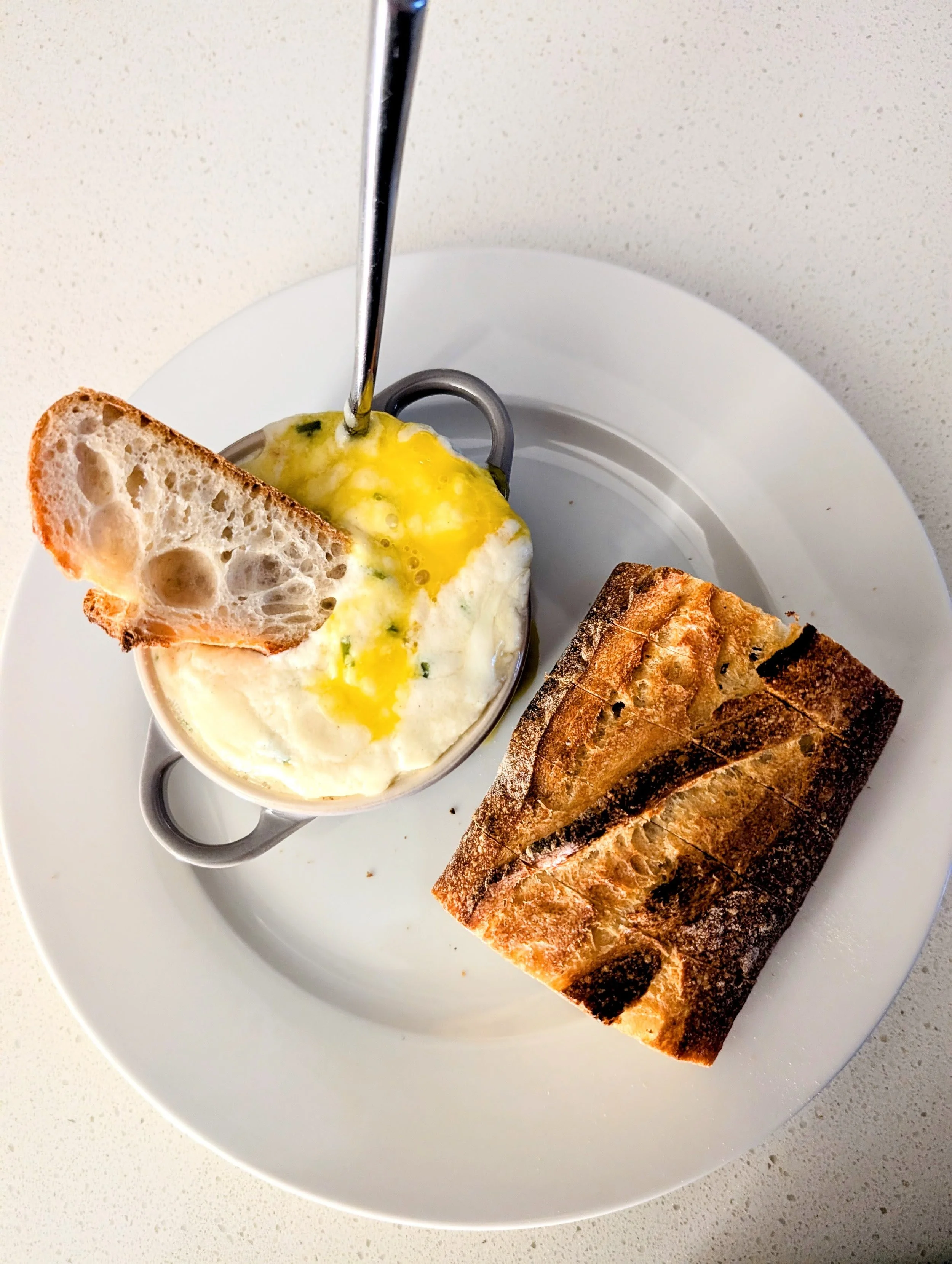
Runny Welsh Anglesey Eggs
Some dishes arrive on the table with a little bit of ceremony, while others seem to have been invented simply because dinner needed to happen.
Anglesey eggs belong to the latter category.
The traditional Welsh dish combines mashed potatoes, leeks, hard-boiled eggs and cheese sauce, sometimes finished with breadcrumbs before baking. It is practical, comforting and decidedly substantial, the kind of supper in which a handful of ordinary ingredients become much more interesting once assembled in one hot dish.
This version keeps the potatoes, leeks and cheese but replaces the hard-boiled eggs with an egg baked directly in the dish. The white sets while the yolk remains soft, ready to spill into the potatoes and cheddar sauce underneath.
It changes the character of the dish considerably. In a very good way.
What are Anglesey eggs?
Anglesey eggs, or Wyau Ynys Môn, are a traditional Welsh dish associated with Anglesey, the island off the northwest coast of Wales.
Classic versions generally combine mashed potatoes and leeks with hard-boiled eggs and cheese sauce, often baking everything together until hot and golden. Breadcrumbs sometimes appear on top for a little extra texture.
Despite the eggs, this isn't particularly breakfast-like. Anglesey eggs are hearty enough for lunch, supper or dinner, with potatoes and cheese turning what might otherwise be a modest egg dish into a complete meal.
Served individually in a cocotte, it becomes especially well suited to a quiet cold-weather dinner, preferably with plenty of toasted bread nearby.
Where do Anglesey eggs come from?
The exact beginnings of Anglesey eggs are difficult to establish. Like many dishes rooted in home cooking, the recipe seems to have accumulated tradition more readily than documentation.
What is certain is the place attached to its name. Anglesey, Ynys Môn in Welsh, sits just off the northwestern coast of Wales, separated from the mainland by the Menai Strait.
The dish's combination of potatoes, leeks, eggs and cheese also feels particularly at home in Welsh cooking: humble ingredients arranged into something hearty enough to anchor a meal.
Anglesey has another intriguing historical association with eggs. In a custom known as clapio wyau, or egg clapping, children visited local homes around Easter carrying wooden clappers and reciting rhymes in exchange for eggs. The practice survived into the 20th century and appears in both written records and oral histories from the island.
There is no established evidence connecting clapio wyau directly to the creation of Anglesey eggs. Still, it is a charming piece of local history surrounding a dish that would eventually carry the island's name.
Are Anglesey eggs eaten for breakfast or dinner?
Dinner is entirely appropriate.
The presence of eggs may suggest breakfast to an American eye, but traditional Anglesey eggs are substantial enough to serve as a main meal. Mashed potatoes, sautéed leeks and cheese sauce put the dish firmly in supper territory.
This runny-yolk version feels particularly suited to dinner. Once broken, the yolk runs through the cheddar sauce and into the potatoes below, turning all three layers into something richer and considerably less tidy.
Which is where the bread comes in.
Do Anglesey eggs have to use hard-boiled eggs?
Traditional versions generally call for hard-boiled eggs, but the basic combination lends itself naturally to a softer variation.
Here, mashed potatoes and tender leeks form the bottom of a small cocotte. A raw egg is cracked into the center, followed by a white cheddar sauce, and the entire dish is baked just long enough to set the white while leaving the yolk soft.
The result falls somewhere between traditional Anglesey eggs and eggs en cocotte.
Instead of slices of firm egg running through the potatoes and sauce, the yolk becomes part of the sauce itself.
Runny Anglesey Eggs
Serves 4
Ingredients
For the potato and leek base
2 cups mashed potatoes
1 1/3 cups thinly sliced leek, white and pale green parts
1 tablespoon butter
Salt and freshly ground black pepper
For the white cheddar sauce
1 tablespoon butter
1 tablespoon all-purpose flour
1 1/3 cups whole milk
1 1/3 cups grated sharp white cheddar
1/4 cup finely chopped fresh chives
Salt and freshly ground black pepper
To finish
4 large eggs
Butter, for the cocottes
Thick-cut toasted bread, for serving
Method
Heat the oven to 375°F.
Melt 1 tablespoon butter in a skillet over medium-low heat. Add the sliced leek and a small pinch of salt. Cook for about 5 to 7 minutes, until completely tender but not browned.
Fold the softened leek into the mashed potatoes and season with freshly ground black pepper.
Lightly butter four small oven-safe cocottes or ramekins, approximately 3 1/2 to 4 inches across. Divide the potato and leek mixture evenly among them and make a shallow well in the center of each.
For the cheese sauce, melt the butter in a small saucepan. Add the flour and stir for about 30 seconds.
Slowly whisk in the milk and cook over gentle heat until the sauce thickens enough to lightly coat the back of a spoon.
Remove from the heat and stir in the white cheddar until smooth. Add the chives and season with salt and pepper to taste.
Crack one egg into the well in each cocotte. Divide the cheese sauce among the four dishes, spooning it over and around the eggs.
Arrange the cocottes on a baking sheet and bake for 10 to 14 minutes, or until the whites are opaque and cooked through, the potatoes and sauce are thoroughly hot and the yolks remain soft.
Serve immediately with toasted bread.