

Fuyu Persimmon and Brie Pastries
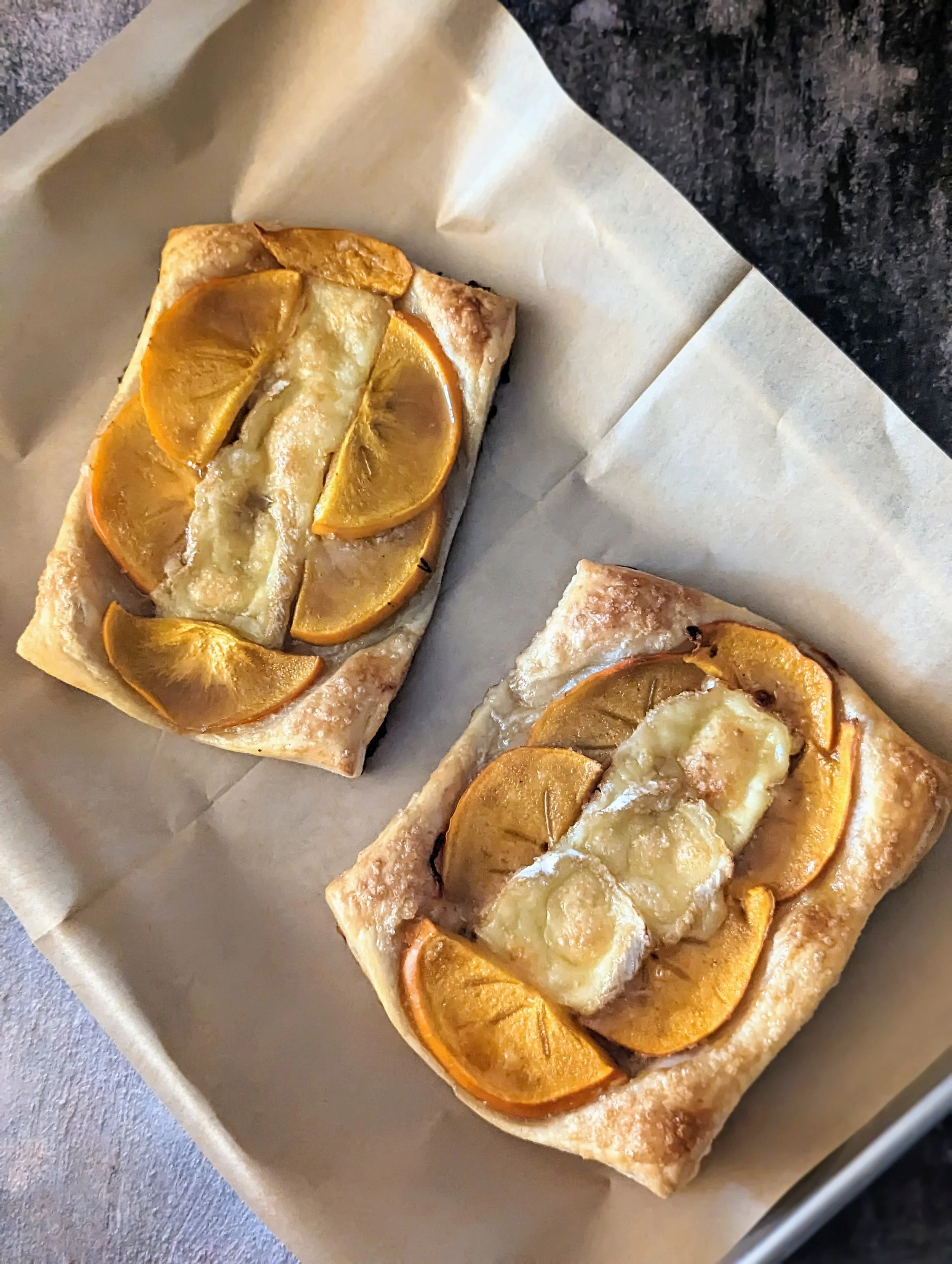
Fuyu Persimmon and Brie Pastries.
The persimmon has always occupied an oddly luxurious corner of the produce aisle.
Not luxurious in the truffled or imported sense, but in the way certain seasonal ingredients feel briefly suspended outside ordinary time: figs in late August, blood oranges in January, persimmons arriving in markets just as the air begins to sharpen in September.
For many Americans, the fruit remains faintly mysterious. Some encounter it only once a year in decorative grocery store pyramids or farmers market baskets, uncertain whether it should be eaten firm, soft, sliced, peeled, or perhaps simply admired. But the persimmon’s history stretches back thousands of years. Native to China and cultivated across East Asia for centuries, Diospyros kaki, often translated as “fruit of the gods”, traveled gradually through Korea and Japan before eventually arriving in the United States during the 19th century.
In Japan, persimmons appear in poetry and seasonal paintings as symbols of autumn’s fleeting beauty. Dried hoshigaki are still made through an elaborate process of peeling, hanging, and hand-massaging the fruit over several weeks until the sugars bloom naturally across the surface. Elsewhere, the fruit became associated with domestic abundance and hospitality: bowls of glowing orange fruit left on tables, sliced persimmons offered after dinner, soft cakes and puddings emerging in colder weather.

A vintage illustration of fresh persimmons from the book Commissioner of Agriculture (1887).
The Fuyu persimmon, squat, tomato-shaped, and sweet even while still firm, is the easiest entry point for modern cooks. Unlike the famously temperamental Hachiya, which must become nearly jelly-soft before eating, the Fuyu can be sliced cleanly while retaining a gentle crispness somewhere between pear and melon. It lends itself particularly well to entertaining because it looks expensive while remaining affordable, especially in late autumn when the fruit appears in abundance.

Vintage persimmons illustration. Original from U.S. Department of Agriculture Pomological Watercolor Collection.
Which is precisely why these pastries work so well for brunch guests or low-effort holiday gatherings. Store-bought puff pastry does most of the labor. Brie, now widely available even in standard supermarkets, melts into something decadent enough to feel far more elaborate than it is. The persimmon softens slightly in the oven, concentrating its honeyed flavor against buttery pastry and warm cheese.
Served warm, the pastries feel fancy enough for a long brunch with coffee and sparkling wine. Halved and topped with a scoop of vanilla ice cream, they become dessert with almost no additional effort at all. This is the kind of cooking that feels increasingly worth pursuing: impressive without exhaustion, seasonal without pretension, luxurious without requiring very much money.
Fuyu Persimmon and Brie Pastries
Serves 4
Ingredients
1 sheet frozen puff pastry, thawed
1–2 Fuyu persimmons, thinly sliced
1/2 wheel brie cheese, sliced
1 egg, beaten
Turbinado sugar
Honey
Directions
Preheat the oven to 350°F and line a baking sheet with parchment paper.
Cut the puff pastry into 4 equal rectangles and place them on the prepared baking sheet.
Arrange slices of brie in the center of each pastry, then layer the persimmon slices over top or alongside the cheese, leaving a border around the edges.
Brush the pastry edges with beaten egg. Drizzle lightly with honey and sprinkle with turbinado sugar.
Bake for 25–30 minutes, until the pastry is deeply golden and puffed.
Let cool slightly before serving warm.
For dessert, try halving the pastries and topping them with vanilla ice cream and an extra drizzle of honey.