

Amelia Simmon's “Pompkin” Pie
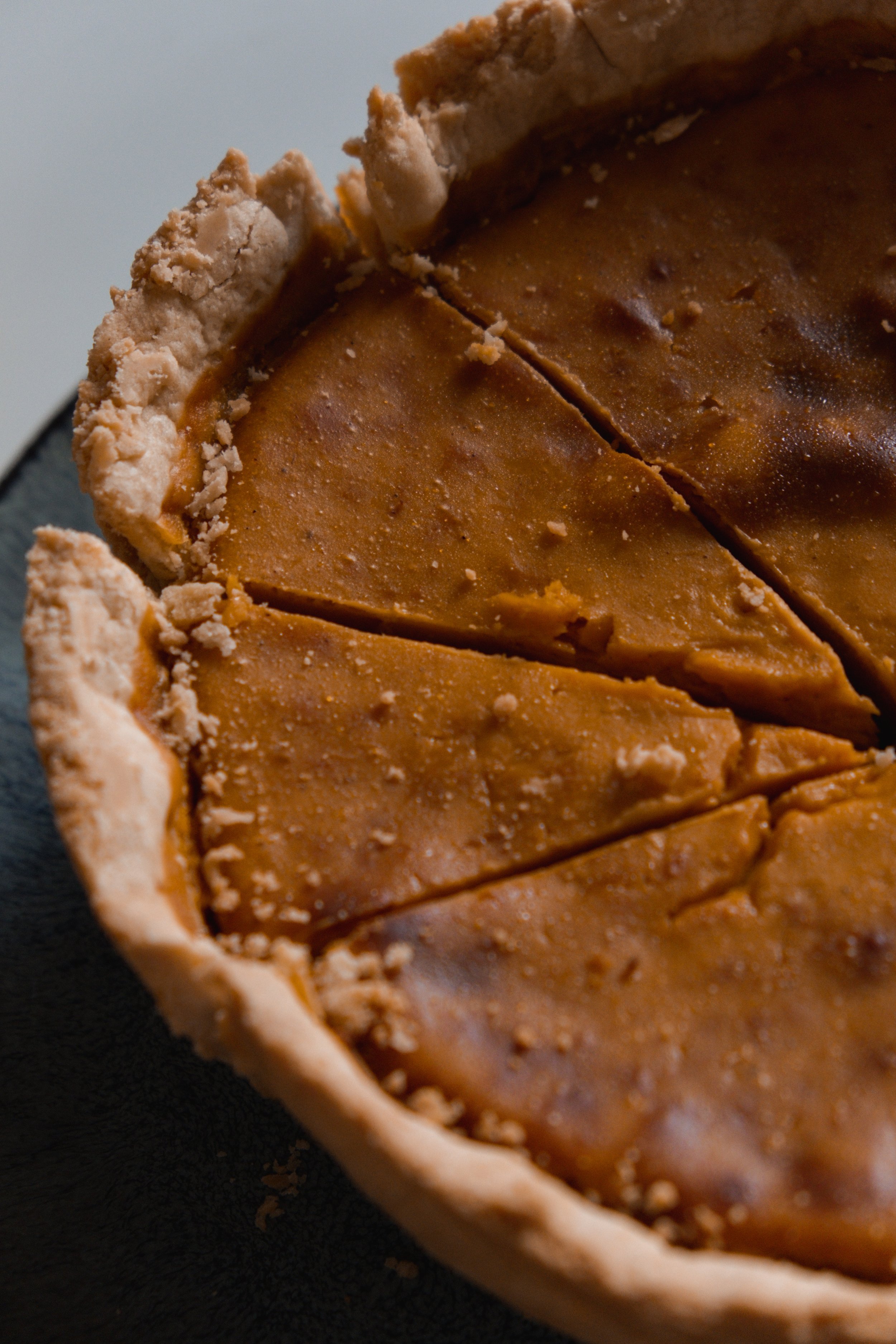
A close-up of pumpkin pie.
Long before pumpkin spice became a seasonal industry unto itself, pumpkin pie existed in a far stranger form.
The versions printed in American Cookery by Amelia Simmons, widely considered the author of the first American cookbook published in the United States, doesn’t read like the standardized pumpkin pies now associated with Thanksgiving but instead like descendants of English boiled puddings and custards. Heavy with cream and eggs, structured, and scented with mace, rosewater, wine, and nutmeg, they belonged to a moment when American cuisine was still assembling itself from regional ingredients, colonial cooking traditions, and improvisation.
Published in 1796, American Cookery helped define what early American food might look like separate from British cookery. Simmons leaned heavily on ingredients native to or abundant in the new nation: cornmeal, pumpkins, cranberries, squash, beans. Her recipes are practical but occasionally eccentric, written in the loose shorthand of 18th-century kitchens where measurements remained approximate and cooks were expected to rely partly on instinct.
The pumpkin recipes are especially revealing. One version resembles the custard-style pumpkin pie still familiar today, though far richer in eggs and cream. Another, sweetened with molasses and spiced with ginger and allspice, feels closer to a rustic baked pudding. Elsewhere in the book, Simmons folds pumpkins into squash puddings alongside apples, wine, dried berries, and rosewater.
Reading the recipes now, what stands out most is how fluid early American cooking still was. Pumpkin pie had not yet calcified into a single canonical form. It was adaptable, inconsistent, deeply seasonal, and tied closely to the practical realities of autumn harvest cooking.
And perhaps that looseness is partly what makes the recipes feel so modern again.
The Original Recipes
The pumpkin and squash recipes in American Cookery reveal just how fluid early American baking still was at the end of the 18th century. These dishes move freely between pie, pudding, custard, and baked squash, often relying on intuition more than strict technique. Measurements remain loose. Ingredients overlap. Rosewater appears beside molasses and cream. Pumpkin shares space with apples, wine, potatoes, and yams.
One recipe, “A Crookneck, or Winter Squash Pudding,” combines boiled squash with stewed apples, bread crumbs, cream, eggs, spices, rosewater, and wine, a dish that feels closer to an English pudding than the pumpkin pies most Americans recognize today. Simmons notes that the same preparation works equally well with pumpkins, potatoes, or yams, reflecting the adaptability expected of early American kitchens.
The “Pompkin” recipes themselves exist in two distinct forms. One is rich with cream and eggs, leaning heavily toward custard. The other, sweetened with molasses and spiced with ginger and allspice, feels simpler and more rustic. Together, they offer a glimpse into a period before pumpkin pie settled into a single standardized tradition.
A Crookneck, or Winter Squash Pudding.
Core, boil and skin a good squash, and bruize it well; take 6 large apples, pared, cored, and stewed tender, mix together; add 6 or 7 spoonsful of dry bread or biscuit, rendered fine as meal, half pint milk or cream, 2 spoons of rose-water, 2 do. wine, 5 or 6 eggs beaten and strained, nutmeg, salt and sugar to your taste, one spoon flour, beat all smartly together, bake.
The above is a good receipt for Pompkins, Potatoes or Yams, adding more moistening or milk and rose water, and to the two latter a few black or Lisbon currants, or dry whortleberries scattered in, will make it better.
Pompkin.
No. 1. One quart stewed and strained, 3 pints cream, 9 beaten eggs, sugar, mace, nutmeg and ginger, laid into paste No. 7 or 3, and with a dough spur, cross and chequer it, and baked in dishes three quarters of an hour.
No. 2. One quart of milk, 1 pint pompkin, 4 eggs, molasses, allspice and ginger in a crust, bake 1 hour.”
The book also provides an array of intriguing pie crust options. From "No. 1," which combines butter, flour, and whipped egg whites to the more substantial "No. 7," where butter and lard enrich yield a delectable crust for sweet meats and heartier pies.
Puff Pastes for Tarts
No. 1. Rub one pound of butter into one pound of flour, whip 2 whites and add with cold water and one yolk; make into paste, roll in in six or seven times one pound of butter, flowring it each roll. This is good for any small thing.
No. 2. Rub six pound of butter into fourteen pound of flour, eight eggs, add cold water, make a stiff paste.
No. 3. To any quantity of flour, rub in three fourths of it's weight of butter, (twelve eggs to a peck) rub in one third or half, and roll in the rest.
No. 4. Into two quarts flour (salted) and wet stiff with cold water roll in, in nine or ten times one and half pound of butter.
No. 5. One pound flour, three fourths of a pound of butter, beat well.
No. 6. To one pound of flour rub in one fourth of a pound of butter wet with three eggs and rolled in a half pound of butter.
A Paste for Sweet Meats
No. 7. Rub one third of one pound of butter, and one pound of lard into two pound of flour, wet with four whites well beaten; water q: s: to make a paste, roll in the residue of shortning in ten or twelve rollings—bake quick.
Amelia Simmon's “Pompkin” Pie, Modernized
Pie filling ingredients:
2 cups canned or homemade pumpkin puree (equivalent to one quart of stewed and strained pumpkin)
2 1/2 cups heavy cream
4 large eggs, beaten
3/4 cup granulated sugar
1/2 teaspoon ground mace
1 teaspoon ground nutmeg
1 teaspoon ground ginger
1 pre-made 9-inch pie crust (store-bought or homemade)
Directions:
Preheat your oven to 350°F (175°C).
In a mixing bowl, combine the pumpkin puree, heavy cream, beaten eggs, sugar, mace, nutmeg, and ginger. Mix until well combined.
Roll out the pre-made pie crust and line a 9-inch pie dish with it. You can also make your own pie crust using modern techniques if preferred.
Pour the pumpkin filling into the prepared pie crust.
Bake the pie in the preheated oven for about 45-55 minutes, or until the filling is set. You can check for doneness by inserting a toothpick into the center of the pie; it should come out clean when the pie is done.
Once the pie is done, remove it from the oven and let it cool to room temperature before serving. You can also refrigerate it for a few hours to chill before serving.
Pie crust ingredients:
1 1/2 cups all-purpose flour
1/2 cup (1 stick) unsalted butter, cold and cubed
1/2 cup lard (or substitute with additional butter)
1/2 teaspoon salt
4-5 tablespoons ice-cold water
Directions:
In a food processor, combine the all-purpose flour and salt. Pulse a few times to mix.
Add the cold cubed butter and lard to the flour mixture. Pulse until the mixture resembles coarse crumbs.
With the food processor running, add the ice-cold water one tablespoon at a time until the dough comes together and forms a ball. You may not need all of the water.
Turn the dough out onto a floured surface and shape it into a disc. Wrap it in plastic wrap and refrigerate for at least 30 minutes before rolling it out for your pie crust.
When ready to use, roll out the pie crust to fit your 9-inch pie dish.